Wyandot County
Named for the Wyandotte Indians who moved into Ohio in the mid-eighteenth century from Canada and Michigan. Wyandot County has plenty to offer visitors to Northwest Ohio. At the heart of Wyandot County is Upper Sandusky (Lower Sandusky is now Fremont), the county seat for Wyandot County.
Wyandot County has a rich historical heritage. The last battle of the Revolutionary War took place here. Early on, Upper Sandusky was home to runaway slaves and more than a few Wyandotte Indians.
Tarhe Monument was erected memory of the great chief of the Wyandots. Tarhe led the Wyandots in peace. He was also one of the signers of the Treaty of Green Ville. When Tarhe died, all of the leading chiefs of the surround states gathered to mourn his loss. This was considered the largest gathering of Native American leaders in Great Lakes and Ohio Valley areas.
Crawford Monument is dedicated to Colonel William B. Crawford who led the Sandusky Expedition to quiet the Indian skirmishes in western Ohio. Crawford was captured and brought back to the spot where the monument stands today. It was here that Crawford was tortured to death.

Wyandotte Mission Church was created by John Stewart, a black Methodist missionary, that tried to Christianize the Wyandotte Indians. His efforts were partly successful until the government decided to move the Wyandotte out of Ohio.

Swartz Covered Bridge built in 1879 spans the Sandusky River on County Road 130a, about 8 miles southeast of Upper Sandusky near the village of Nevada. The bridge has been fully restored thanks to efforts of private donations.
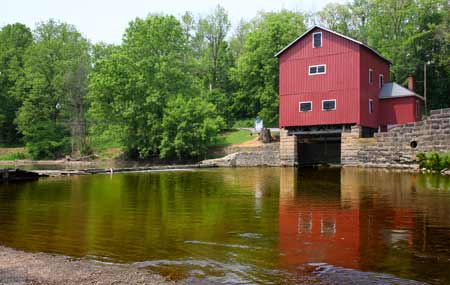
Indian Mill located along the Sandusky River houses the the nation's first educational museum of milling. Named the "Indian Mill" because its predecessor was built for the Wyandotte Indians, the last group of Native Americans to be forced out of Ohio, by the US government.
John Stewart and the Wyandots
In the 1810s, a self proclaimed Methodist minister John Stewart, an African American, established a mission at Upper Sandusky. He and James Finley spent the 1810s and 1820s encouraging the Wyandots to convert to Methodism. They were quite successful.
By the mid 1820s, a number of Wyandots had set aside their traditional ways and beliefs. Many were farmers. They built log cabins with brick or stone chimneys and raised sheep, cattle, and hogs. After trying to accommodate to white ways, the United States government forced the tribe to leave its land in Ohio for territory west of the Mississippi River in 1843.
The Wyandots were the last major group of Indians to leave Ohio. When whites originally moved into Ohio in the mid to late 1700s, many lived in fear of the Indians. By the 1840s, only a handful of Indians remained, and the whites viewed them more as a curiosity than as a threat. Nonetheless, the United States forced the Native Americans to relinquish their land.