Wyandot Indians
Of all the Native Americans that lived in Ohio, the Wyandots were most closely related to the state. Other Native American Nations that came to the land known as Ohio would seek permission from the Wyandot. Although there were hostilities between the whites and Wyandots, once the Wyandot signed the peace treaty with General Anthony Wayne, few of the Wyandot would ever take up arms against the Americans again.
In return for signing this treaty, the Wyandot were granted permanent use of the land along the Upper Sandusky River that was called the Grand Reserve. Here they began farming on a productive scale. The built a school and with the help of the federal government built a grist mill.
ABOVE: Wyandot Mission House today, surrounded by cemetery. The mission was looted and burned, the graves were desecrated by locals after the remaining Wyandot's left in 1843
In 1830 the federal government passed the Indian Removal Act which was designed to relocate by force if necessary, all Native American nations living east of the Mississippi River to designed lands west of the Mississippi. The act also the President complete authority over the Native Americans. With the passage of this act, treaties were quickly worked out among the major Native American nations. Smaller groups such as the Wyandot, were ignored for the time being.
Perhaps what invoked the most contempt from local residents was when the Wyandots established a Methodist Mission house led by a black minister. The area soon became a refuge of sorts for escaping slaves. That combination was enough to create an uprising of enough voices to force the federal government to withdraw their treaty of the Grand Reserve and enforce the decade old Indian Removal Act.
The once fierce and feared Wyandot were now a mild, peace-loving nation. They wanted nothing more than to get along with their black and white brethren, and they could not understand why they weren't welcome in their own land any more. A treaty was finally signed between the government and the Wyandot that gave up their claims to any land in Ohio and were forced to leave.
The summer of 1843 brought many tears to both the Wyandot and many Ohioans as the last of their members walked the final miles to board steamers in Cincinnati that would take them west. For others who had sought their removal, those days were celebrated with wanton destruction of all that the Wyandots had built and held dear.
Wyandot History
The Wyandot Nation is a rarity in the Native North American history. Unlike most North American Native Americans, there was a specific time line ascribed to their creation. Originally, there were the Tionontati and Attignawantan Nations living in southern Ontario and upper Michigan. These were 2 distinct Nations that spoke similar languages with similar cultures. They were also hated by the Iroquois Confederacy (the confederacy was made up of Mohawk, Onondaga, Seneca, Oneida and the Cayuga). This Iroquois Confederacy waged a long war with them and ultimately drove both Nations from their land during what became known as The Beaver Wars.
This war was all about land, wealth and power. European demand for beaver pelts had exhausted the animals from most of the northeast. This meant what few beaver skins were available, were worth more. To satisfy the demand, the Iroquois, who were the primary suppliers of the beaver pelts, began moving west into lands controlled by a number of other tribal nations, but who weren't as organized or as powerful as the Iroquois.
Compared to later conflicts, the Beaver Wars was an extremely brutal conflict that lasted for generations. When it finally ended, the Iroquois had greatly enlarged their holdings in North America. A number of tribal confederacies had been forced out, leaving much of the Northwest Territory, and in particular, the Ohio Country, mostly abandoned. It was this vacuum that the two nations, Tionontati and Attignawantan, would seek refuge from the Iroquois.
The formation of the Wendat
Facing extinction at the hands of the Iroquois the two Nations came together as one in 1650, calling themselves the Wendat. They were also called Hurons by the French which in French meant head of the wild boar, referring to the roached hair of the warriors that resembled the bristles on a boar's head. The Wyandots never accepted that term. They called themselves "Wendat" which meant islanders or dwellers on a peninsula. In time the Wendat became known by the French term Wyandotte, and later by the English term Wyandot.
Still hunted by the Iroquois, the Wyandot sought to establish a peace with the Iroquois which was achieved in 1700. The Wyandots initially settled in around the Detroit area and eventually migrated into the Ohio territory past the Great Black Swamp, along the Sandusky River. The area now called Upper Sandusky, near the headwaters of the Sandusky River, became their center with villages running through what is now Wyandot, Marion, Sandusky and Crawford Counties. In time, their nation spread across most of northern Ohio with some villages being established as far south as Ross County.
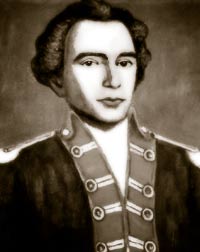
Colonel William Crawford
As the American Revolutionary War began to spread past the 13 colonies, the British sought allies who might benefit them on the western frontier. By this time the Wyandots had become the most widespread group south of Lake Erie, they seemed the most logical for the British to seek out. With the promise of money, supplies and arms from the British, the Wyandots, as did many of the other Native Americans in Northwestern Territory, became allies with the British to fight against the Americans.
There were a few conflicts mostly in eastern Ohio. In particular at Fort Laurens, which is south of where present day Canton is located. Here there were several engagements. An even more atrocious event happened just south of there at a Moravian Missionary village called Gnadenhutten.
The Moravians had long held a missionary position with the Native Americans. Their belief was to have a few missionaries teach the Indians about Christianity and living in settlements much like the American villages in the east. They had become friends with several important Delaware that gave them land to establish new villages west of the Ohio River. This cooperation between the tribal nations and the Americans brought the ire of the Iroquois who had long been suspicious of the Christian missionaries. It was the Iroquois that hatched a devious plot that would not only destroy the missionaries, but the Wyandots would take the blame.
Wyandot Revenge
The Iroquois convinced the British that the Moravian Missionaries were actually spies working for the Americans and that they should be removed. A small number of British combined with a much larger group of Wyandotte left the Detroit area to seek out the missionaries. Once they found their village, they went further east and attacked a small American settlement, killing many. After this attack they once again returned to the missionary village at Gnadenhutten. They took the missionaries prisoner and forcefully scattered the Native American villagers. After this they headed back to Detroit with the prisoners.
After a severe winter the Christian Indians had no option but to return to the village the following spring in hopes of salvaging some of their crops that had gone unharvested the previous fall. At about the same time, a group of American militia came upon the scavenging villagers. Thinking that they were responsible for the killings at the American settlement because one of the Indians was wearing a dress owned by one of the families, the militia methodically killed all of them. The bloody killings became known as the Gnadenhutten Massacre.
Colonel Crawford
Later that year, an American expedition, led by Colonel William Crawford came up from around Cincinnati to seek out at the heart of the Wyandot around the Sandusky River area. As the Americans approached the area, they came in contact with a group of Wyandot and Delaware and a battle ensued.
During this fight, which lasted several days, the American forces held their own. However, as their supplies began to run short, the Americans made efforts to withdraw. At the same time, the Wyandots received reinforcements by British rangers and a band of Shawnee. Bolstering their number. The combined forces surrounded Crawford's men and during the confusion, a number of the Americans were captured with the bulk of their force escaping to the south. Colonel Crawford became separated from his men, and avoided capture by hiding in the thick woods. After a day he was captured.
During the interim, the Wyandot began to suspect that it was this group that was responsible for the massacre of Indians at Gnadenhutten. With the capture of Crawford, the Wyandot's decided to make the most of the situation and lay complete blame for those killings by sentencing Col. Crawford to death as revenge for the massacre. Crawford was ultimately tortured and finally executed by being burned alive at the stake.
Although the end of the Revolutionary War brought an end to hostilities in the east, the British were still urging the Wyandots to be careful of the untrustworthy Americans. It was even suggested that they were paying a bounty for every American scalp taken. Eventually these conflicts led to an extensive military campaign against the Native Americans in the Ohio Territory that culminated in the Battle of Fallen Timbers in 1795.
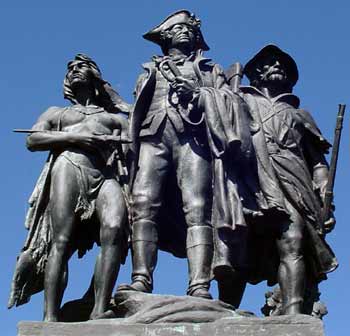 During this battle, most of the Wyandot Chiefs fighting in the battle were killed by American forces under General Anthony Wayne. Leather Lips and Tarhe survived the battle and though severely wounded, they both signed the Treaty of Greenville.
After the treaty was signed, Chief's Tarhe and Leather Lips decided it was better for the Wyandots to seek a path of coexistence with the Americans rather than trying to continue the fight against them. One exception to this coexistence was the Wyandot Chief Stiahta (Roundhead) and his brother John Battise.
The 2 brothers were convinced it would be better to continue the fight with the Americans. To this end they sided with the Shawnee leader Tecumseh in his efforts to unite as many Native Americans as possible against the United States. Stiahta and his brother both became enforcers for Tecumseh.
After the treaty signing, Tecumseh vowed death to all of the signers of the treaty if they didn't recant. To that end, Stiahta, under the guise of a fake trial issued a death warrant against the aging Wyandot Chief Leather Lips. In a dramatic account, that warrant was carried out in 1810 at his small camp in Delaware County just south of where the Columbus Zoo is now located. Leather Lips led a mostly solitary life after the war, unlike Tarhe, who was immersed in a large village making it impossible for Tecumseh to make good on his threat against him.
When war once again broke out between the British and the United States, Tecumseh sought a decisive defeat against the Americans by joining forces with the British. Although the war ended in an essential tie between the two countries, the Native American's were dealt a crushing defeat when Tecumseh and Roundhead were both killed toward end of the war. With their demise, so came the demise of the efforts to unite the Native Americans.
But not all the Native Americans in Ohio sided with the British. After repelling the British at Fort Meigs and Fort Stephenson, General Harrison assembled a massive army that would pursue the British and Tecumseh back into Canada. Among those who joined Harrison were about 260 friendly Wyandot, Shawnee, and Seneca Indians. Together they pursued the British back into Canada.
After the War of 1812, a period of relative peace existed between the Wyandots and the American settlers.
In 1817, the Treaty of the Maumee Rapids was signed between the government and the remaining Native Americans living in the northwest including the Wyandot. This treaty ceded their claim to 4,000,000 acres of land in northwestern Ohio. In return the government agreed to pay $4,000 to the Wyandots, with the other groups receiving lesser amounts each year for 15 years. The Wyandots also received a 12 square mile reservation at Upper Sandusky.
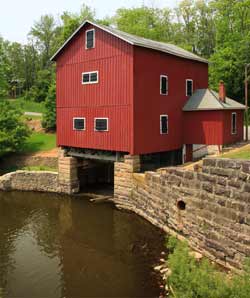
With this reservation along the Upper Sandusky area in Wyandot County, it became the gathering place for Wyandot's from around the country. Here they continued their peaceful ways and farmed the land. In 1820 a flour mill was built near Upper Sandusky to help serve not only the Wyandot farmers, but it was also the only mill in the area and settlers would send their harvest to the mill for processing.
In 1824 the Wyandot Mission Church was built and became the first North American Methodist mission. The Wyandots as a group began to incorporate the American settler's lifestyles through increased farming, raising livestock, and building log cabins with chimneys.
Even though the Wyandots were peaceful, there was still a deep sense of distrust between the races. Adding to the distrust was the increasing number of blacks that had found comfort living with the Wyandots. Although Ohio had outlawed slavery, this did not mean Ohio was completely free or free of bigotry.
The state constitutional convention prohibited black men from voting, serving in the militia, on juries, or testify in court against whites. Even their children were banned from public schools. Many whites actively sought to prevent blacks from coming to Ohio, fearing a loss of jobs to African-American workers. It was this growing deep seated distrust and the increasing number of blacks finding refuge with the Wyandots that finally led to the removal of the Wyandots as a group from Ohio.
 LEFT: Small cemetery located about 1000' east of Wyandot County Courthouse near the location of Fort Ferree just north of the cemetery. Fort Ferree was built as a supply depot during the War of 1812. The marker indicates a Wyandot Council House was located just south of this marker. The cemetery had graves for both military personnel, early settlers and Wyandots. Most all of the markers for the Wyandot's were removed / destroyed after the Wyandots were forced to leave in 1843.
Many Wyandot's remained in Ohio, even after they were physically forced out as a group by the United States Government. In 1842 the federal government demanded the remaining Wyandots to give up their claim for the set aside lands at Upper Sandusky given to them in the Treaty of the Maumee Rapids. In return for giving up this 12 square mile tract of land, they were promised better lands west of the Mississippi River. In 1843 the government sent them off to a reservation in Kansas. They were the last Indian Nation to leave Ohio although there were numbers of individual Wyandots throughout the state who remained here the rest of their lives.
 Bill Moose Crowfoot
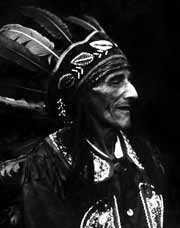
One notable exception to the removal of all the Wyandots was Bill Moose Crowfoot who was born in 1837. When the majority of the Wyandots left for Kansas, Crowfoot's family along with several other families moved south from their original home near Upper Sandusky. This small band took up residence just north of Columbus in the area between the Scioto and Olentangy Rivers that had been a traditional Wyandot village in years prior to when Lucas Sullivant first arrived in the area.
 Bill Moose became a notable figure around Columbus during the late 1800s and early 1900s. For a time he was a member of the Sells Brothers Circus that traveled through the US, Canada and Australia.
When his traveling days came to an end, Bill came back to the land where he grew up and built a small shack just north of Columbus near what is today the intersection of Indianola and Morse Roads.
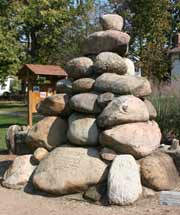
Bill always welcomed guests to his little house and was happy to pose for photographs wearing his headdress and blanket. He lived off telling stories, posing for pictures and selling trinkets to visitors. As his health began to fail, Bill spent the last 7 years in the Franklin County Home. Bill Moose Crowfoot is buried along the Scioto River just north of Upper Arlington on US33 between Fishinger and Henderson Roads. Bill Moose Crowfoot became known as the last of the Ohio Wyandots when he died in 1937.