1812 American Flag

The War of 1812

The War of 1812, sometimes called the Second War of Independence, was fought for sailor's rights and western expansion. Great Britain was stopping American merchant ships on the Atlantic Ocean and impressing sailors into the Royal Navy. In response, the United States declared war on June 18, 1812. Fort Meigs stood at the center of American military operations in the Northwest Territory

Hours:

Wednesday - Saturday:
9:30 a.m. - 5 p.m.

Sunday: 12 p.m. - 5 p.m.

Fort open: April - October

Museum open year-round

Fort Meigs

Send a free online Greeting Card from Touring Ohio featuring
Fort Meigs >>


William Harrison

Harrison leads attack on the British Navy on Lake Erie

General Harrison in Fort Meigs learned that part of the British fleet on Lake Erie was trapped by ice. On March 2, 1813 Harrison led a force of 170 men on sleighs. Leaving their sleighs at Middle Bass Island, they, marched northward, only to find that the ice had broken up and freed the ships.

General William Henry Harrison left the army soon after the war and began his political career. He was first elected to the Ohio General Assembly and in 1840, was elected President.

More information about Harrison>>


Home >

Fort Meigs

Fort Meigs

Fort Meigs is a War of 1812 battlefield located in Perrysburg just south of Toledo. A reconstructed fort and museum help bring this important American history alive with the recreated full-size fort, some of the original earthworks and a museum with actual artifacts found during archeological excavations prior to rebuilding the fort. Along with school tours and interactive displays, a number of reenactments and special events take place here throughout the summer. Dedicated staff and volunteers allow Fort Meigs to bring fun and education to hundreds of visitors each year.

Fort Meigs

Fort Meigs, the largest reconstructed wooden fort in Ohio includes 10 acres of land and has a mile perimeter overlooking the Maumee River. Fort Meigs stood as an important stronghold against the British during the War of 1812. In the 1960s the Ohio Historical Society purchased the site to rebuild the fort, and in 1974 the reconstructed fort was opened to the public.
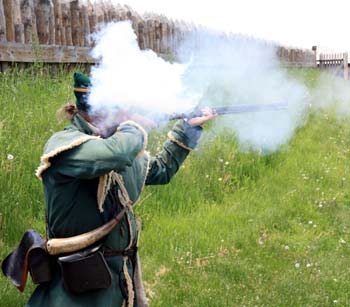
Re-enactorsVisits to the Fort include authentically dressed guides that are more than willing to talk about all aspects of the fighting men and women that lived in the fort during 1813. They will also give you a step-by-step demonstration that a rifleman went through in firing their flint-lock.

Many events throughout the warmer months depict what went on at Fort Meigs during the war such as the First Siege event held in late May. The First Siege includes a re-enactment of the British's first attempt to take over the fort as well as other demonstrations throughout the day. The fort also hosts several other events that include Vikings and Roman Legionnaires, and events about the 1812 culture and frontier life.

General admission into the fort and the museum is $7 for adults, $3 for students and children five years old and under get in free. If you're at all interested in Ohio and American history, then Fort Meigs is well worth the visit.

Fort Meigs Model of the Construction

How the fort came to be

Between June, 1812 when war was declared by the United States against Great Britain, and February, 1813, the United States lost a number of outposts in the Northwest Territory including Fort Mackinac, Fort Detroit, and Fort Dearborn as well as a major defeat at the Battle of the River Raisin in Michigan. Only Fort Wayne, in the Indiana Territory, withstood British attack.

To regain the initiative, General William Henry Harrison amassed a new army from his headquarters in Franklinton and Urbana. In early 1813, Harrison and his men moved north and established a fort on the southeast side of the Maumee River on February 2, 1813. The site was well chosen. Strategically, the fort was located at the foot of the Maumee River rapids which was as far as British supply ships go up the river from Lake Erie. At this point they would have to unload their supplies and transfer them to smaller boats able to navigate the river. Besides protecting the river, the fort would also serve as a supply depot and staging area tha would allow Harrison and his army to prepare for the retaking of Detroit and the upcoming invasion of Canada.

Construction of Fort Meigs took 3 months to complete. Living conditions at the fort were horrible; mud as deep as a man’s knee, mosquitoes, disease, and exposure to the weather all contributed to a high death rate among the men stationed there.

From Captain Eleazer D. Wood, U.S. Corps of Engineers
March 1813:

The Indians were getting to be quite troublesome round the camp; no part could be sent out after fuel, timber, or anything else without being fired upon and frequently one or two persons killed and as many more taken prisoner.

The fort was to serve as a temporary supply depot and staging area for the upcoming planned invasion of Canada. Named for the Governor of Ohio, Return Jonathan Meigs, the garrison was a home for more than 2,000 men comprised of U.S. both of regulars and militia from Ohio, Kentucky, Pennsylvania, and Virginia. At the height of construction there were over 3,000 men and women at this location.

Down the center of the fort's interior, a pair of long earthwork walls were constructed the length of the fort to deflect cannon balls coming from across the river from doing extensive damage. There were also shorter walls constructed perpendicular to these to deflect cannon fire from coming the northeast.

Fort Meigs Battle

When the enemy laid siege to Fort Meigs on May 1, 1813, they found General Harrison ready. With a strong fort, 1,200 troops, and 20-30 pieces of artillery, the garrison dug in with the knowledge that reinforcements were on the way. The bombardment ended after 4 days, when a troop of Kentucky militia arrived to reinforce Fort Meigs. On May 9, the enemy lifted the siege and returned to Canada. The Indians who had accompanied the British during the siege were bitterly disappointed by their failure to take the fort.

Fort Meigs CannonIn July, 1813, the British attempted to appease their Native American allies by again besieging Fort Meigs. The Indians staged a mock battle to lure the garrison out. The Americans, however, saw through the ploy. After the failed siege attempt, the British moved on to Fort Stephenson, where Fremont, Ohio stands today. That attack also failed, causing heavy British losses and again forcing a retreat to Canada.

On September 10, 1813, Commodore Oliver Hazard Perry defeated a British naval force on Lake Erie, giving the United States the upper hand in the Northwest. Harrison transferred all but 100 men from Fort Meigs north to Canada and ordered the fort dismantled. In its place, a small, square stockade was constructed to serve as a supply base and to protect the Maumee rapids.

The site was preserved by the Hayes family who purchased the land and used it for grazing cattle. In 1840, William Henry Harrison returned to the site to hold a rally during his successful run for the Presidency.

In 1908 the Grand Army of the Republic, an organization of Civil War veterans, held a reunion in Toledo, Ohio. To commemorate their arrival, and to honor the memory of the soldiers who served at Fort Meigs, a monument was erected on the site.

Fort Meigs Museum

The Museum

The Museum and Education Center has 3,000 square feet of exhibits and artifacts - including soldiers' letters and diaries, weapons, maps, and uniforms describing Fort Meigs role during the War of 1812.

Exhibits themes include The Lore of the Land, The Sixty Year War for Ohio, and Building Fort Meigs. Original artifacts from the War of 1812, including swords, uniforms, and maps highlight the events of the war and the impact it had on soldiers and their families.

There is also a well made video that explains some of the reasons for the War of 1812, the important role that Fort Meigs played in the War of 1812 and how the original fort was recreated.

Exhibits emphasize hands-on and interpretive learning opportunities for students and families, as well as workshop and curriculum resources for teachers. The museum also includes a well stocked gift shop that offers informative literature and items directly related to the War of 1812, and items for the children. Classroom and conference rooms are also available.

Fort Meigs Museum

Additional information about Fort Meigs can be found at: http://www.fortmeigs.org/

Visiting Fort Meigs

Allow plenty of time to walk through the museum and tour the fort. Walking the grounds of the fort and looking at displays throughout the grounds, and talking with the guide can easily take several hours (wear comfortable shoes). You can also easily spend an hour inside the museum.

See also:

Perrysburg