

National Road Tourists
The National Road had long been a major transportation route across Ohio. With the introduction of the automobile in the early 1900s, the National Road once again became an important route from here to there, with the exception that it was now used for vacation travel. In the early days of the National Road, the pike was used mostly to move people immigrating from the east into Ohio and the states west. During this time tolls were collected for using the road and a series of toll-houses were built every 20 miles or so.

When the automobile became popular, it was decided that the tolls were no longer needed and the pike became a national highway. Early travel by automobile across the road was not easy. During the wet months the road would become almost impassible.
In 1914, a 29-mile test section was built between Zanesville and Hebron to see how feasible installing a concrete road might be for improving the long neglected pike. This section became the model concrete road of the world. Today, there is a monument located just west of Brownsville at a point called the "Eagles Nest." This monument is a dedication to that test road.
Auto Tourists
Auto tourists became a new phenomenon. Auto tourists would take off on cross-country trips and sleep in farmer's fields or tents. In the 1910s and 20s, tourist camps sprang up along the National Road. These private camps provided a place for the auto tourist to stop for the night. These camp grounds provided not only a safe place to stay, but many had running water and toilet facilities, a big step up from sleeping in a corn field.
Providing shelter for auto tourists
With increasing traffic along the road, a new breed of entrepreneur set up businesses to serve these new auto tourists. Cabin camps were the first to spring up, a big improvement over the camp grounds. The cabin camps were the predecessors of the motel.
Tourist cabins were small buildings just one-room deep with a rectangular shape and gabled roofs. They were usually grouped in a row or in a semi-circle, with space for a parked car next to each cabin. Several examples still remain along the byway corridor. The term cottage was soon used to describe these cabin camps become more luxurious.
During the Great Depression of the 1930s a number of homeowners decided to open their large houses for overnight guests and these private residences became known as Tourist Homes. Although not always easy to spot you can still see some private homes along the National Road that served as Tourist Homes.
Motor courts and motels began to appear in the 1940s, and most along the National Road in Ohio date from the 1940s and 1950s. As opposed to the separate cabin units, rooms were placed together in a single building under a single roof, often with a full-width porch or projecting roof line to provide shelter. Motor courts are arranged in a courtyard configuration. Linear motels are long horizontal structures that align with the road they serve. The motor courts and motels along the National Road in Ohio are mostly one-story structures. Many had offices, coffee shops or restaurants.
Feeding the tourists
As more Americans took to the road for recreation, the number of restaurants grew as well. Restaurants were, of course, located on the main streets of cities and towns but they were also positioned all along the route, even in the most isolated rural stretches of the road. During the 1940s and 1950s, restaurants were often associated with a motel. Stylistically, restaurants ranged from the traditional to contemporary, and often included oversized signs designed to attract the attention of the traveler.
Gas stations
Besides food and shelter requirements, Ohio's tourists need gasoline. The earliest gas stations were usually built of frame and had a canopy over the front to give protection while filling up the tank. During the 1920s and 1930s, gas stations added services such as lubricating and repair, and the structures incorporated one or more service bays. Often an effort was made for the station to be almost residential in appearance, with the cottage-theme being most common. The stations often advertised their corporate affiliations through their design, colors and signage.
 Bikers on the National Road
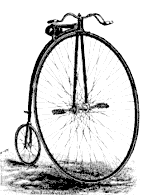
Several years before the automobile became a popular form of transportation, bicyclists took to the National Road. These biking enthusiasts brought new life to the old road as they began organizing events that traveled various sections of the highway. Such enthusiasts organized the League of American Wheelman, an organization that promoted bicycles and bicycle safety. Through their efforts they helped create the "Good Roads Movement" throughout the country.
Drive-In Theaters
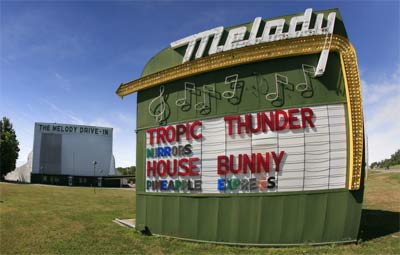
In the 1950s, Americans had settled down from World War II and the Korean War and were looking for new ways to entertain themselves that included their automobiles. One of those entertainment venues was the Drive-In Theater. These new theaters were first developed in New Jersey in the 1930s, but they quickly spread across the country. The big draw was the comfort of a freshly washed car, taking the entire family, including all those new baby-boomers for a night out. Teenagers found that a night at the drive-in made for an almost perfect date.
One of the few remaining Drive-Ins in Ohio is the Melody Cruise-In Theatre located on the National Road just west of Melody. The drive-in opened in 1952 and is still in operation.
See also:



 In 1930 Ruth Wakefield created the famous Toll House cookie. The name used for the cookie was based on the fact that she lived in an old cape-cod building which was a converted toll-house halfway between Boston and New Bedford.