Chief Tarhe
Tarhe, (pronounced Tar-Hay) Grand Sachem of the Wyandotte Nation was 6'4" tall in an era when few men of the day were even 6'. Chief Tarhe's Indian name is supposed to mean crane or tall fowl, but this is a mistake according to the Wyandots.
Crane is merely a nickname given him by the French because of his height and slender build. Chief Tarhe had no English name, but the Americans adopted the French nickname. It is thought that the Wyandottetranslation of his name meant the tree.
Although Tarhe lived at various locations in Ohio including present day Lancaster, Columbus, Solomonstown, Zanesfield, an area northeast of Upper Sandusky is where Tarhe is most associated and where he died. The flat land and his village became known as Cranetown and was located a few miles west of the small village of Smithville on Township Highway 37A
Tarhe's Early Years
Tarhe was born near present-day Detroit in 1742 and he belonged to the Porcupine tribe of the Wyandottes. Like many Native peoples, Tarhe opposed white settlement of the Ohio Country. He fought to prevent the invasion of American settlers onto the land they had used for a number of years.
It has been suggested that perhaps a young Tarhe was present along with other Wyandotte's at a battle against General Braddock in western Pennsylvania in 1755 during the French and Indian War. During this battle General Braddock was killed. Also present at this battle was a young George Washington.

In 1763, the British made a proclamation in an effort to appease growing tension between the British and Native Americans that prohibited white settlers from the land west of the Appalachian Mountains. This proclamation was actually nothing more than empty promises and few pioneers obeyed the edict.
With the increasing number of white settlers encroaching on lands north of the Ohio River, conflicts between Native Americans and these settlers were also increasing. Even those Native Americans that viewed the settlers as interesting contacts were not safe. Several early encounters between friendly Indians and unfriendly pioneers last life-long scars that spread throughout the Native peoples that the whites could not be trusted.
Tarhe and Chief Logan
In one incident, a friendly village of Mingo's, that welcomed early pioneers into their village, was attacked by British colonists when they misunderstood their gestures. The attack resulted in the death of 11 Mingo Indians. Most of those killed were part of Chief Logan's family. Chief Logan who was away from the village at the time, begged Chief Cornstalk of the Shawnee, to seek revenge against those who had committed this atrocity. Cornstalk, though reluctant to do so, sent 24 warriors into western Pennsylvania where they killed 13 settlers in revenge.
In response to this attack the governor of Virginia, John Murray, the 4th Earl of Dunmore, sent more troops to settle the conflicts. As word spread among the Native Americans of the advancing military force, more than 1200 Shawnee warriors gathered near where Point Pleasant is located today. The 32 year old Tarhe accompanied Chief Cornstalk to this battle. This conflict was referred to as "Lord Dunmore's War."
Lord Dunmore's War
At first, the Native American coalition encountered Colonel Lewis' brigade. There were heavy casualties on both sides. Then Lord Dunmore's men arrived and joined the battle. This forced a retreat by the indians. Realizing that the situation could only get worse, Chief Cornstalk asked for a peace. Under the terms of this treaty, the Indians gave up all their prisoners and promised not to go south of the Ohio River. Likewise, the English colonists would not go north of the Ohio River.
Tarhe the Grand Sachem
Tarhe helped negotiate many treaties during the time he was Grand Sachem. He repeatedly attempted to hold his tribe together and to serve other tribes in the area as well.
During his lifetime, he fought against Rogers Clark, Boupuet, Marmar, St. Clair and Anthony Wayne. Although Tarhe was eventually defeated, both his enemies and friends knew he was dedicated first and last to the welfare of his people.
It is believed the last battle Tarhe fought in personally was in 1794 at Fallen Timbers. That action was a brief but devastating one for the allied tribes. The only tribe to fight with distinction that day was the Wyandottes. They were pinned down near the river and suffered heavy casualties. The Wyandotte chiefs were decimated. Of the 13 chiefs who entered the battle, only Tarhe survived and he suffered a severe wound in the right elbow. After the battle word was sent to the Wyandotte women and children to flee from their camp along the Upper Sandusky north to Lower Sandusky and Sandusky Bay. They feared that the Americans would attack the village and kill all of them. Although severely wounded, Tarhe left the battlefield and went to Sandusky Bay where he recuperated. General Wayne, rather than pursue Tarhe, temporarily suspended hostilities and later withdrew from the Maumee River south for a winter camp at Greenville.
It took a number of months for Tarhe to recover from his wounds, but having done so, he left Sandusky to meet with General Wayne and discuss the terms of the treaty in January 1795. Once the those terms were agreed to by those present, they had to be agreed to by the leaders of each side. That took a little over six months, and they finally returned to Greenville for the signing. As all the parties came together, Tarhe gave an impassioned speech to his fellow people. The following is a translation of that speech recorded at the time.
Tarhe's speech at Greenville Treaty signing:
Elder brother! Now listen to us. The great Spirit above has appointed this day for us to meet together. I shall now deliver my sentiments to you, the fifteen fires. I view you, lying in a gore of blood. It is me, an Indian who caused it. Our tomahawk yet remains in your head- the English gave it to me to place there.
"Elder brother! I now take the tomahawk out of your head; but with so much care you shall not feel pain or injury. I will now tear a big tree up by the roots and throw the hatchet into the cavity which they occupy; where the waters will wash it away to where it can never be found. Now, I have buried the hatchet, and I expect that none of my color will ever again find it out. I now tell you that none in particular can justly claim this ground- it belongs in common to all. No earthly being has an exclusive right to it."
(Spoken on a blue belt.)
"Brothers, the fifteen fires, listen! You now see that we have buried the hatchet. We still see blood around, and in order to clear away all grief, we now wipe away the blood from around you, which together with the dirt that comes away from it, we bury with the hatchet in the hole we have made for them, and replace the great tree, as it stood before, so that neither our children, nor our children's children can ever again discover it."
(Spoken on a blue string attached and both delivered.)
"Brothers, listen! I now wipe your body clean from all blood with this white, soft linen (a white wampum) and I do it with as much tenderness as I am capable of. You have appointed this house for the chiefs of the different tribes to sit in with you, and none but good words ought to be spoken in it. I have swept it clean- nothing impure remains in it.
"Brothers, listen! We are both placed on this ground. I now wipe the tears from your eyes and open your ears. I see your throat is so stopped that you are nearly suffocated- I now open your throat and make it quite clean, that whatever the Great Spirit may think proper for you to swallow may go down without any obstruction. I see also that your heart is not in its true situation- I now place it in its proper position, that anything you may hear from us, your brothers, may descend directly to it, and what you shall say may come with truth and ease from it.
"Brother! I clear away the hovering clouds that we may enjoy a clear, bright day; and easily see the sun which the Great Spirit has bestowed on us, to rise and set continually."
(A white string.)
"Brother! Listen to us Indians, who now speak to you. The bones which lie scattered of your ancient warriors who fell in defense of the present cause, we gather all together, and bury them now, and place this white board over the, that they may never again be seen by our posterity."
(A white belt and string.)
"Brother warrior! Listen to us. The great chiefs are about to speak to you. Your chiefs and warriors present, listen also.
"Brother! We speak not from our lips, but from our hearts, when we are resolved upon good works. I always told you that I never intended to deceive you, when we entered upon this business. It was never the intention of us Indians to do so. I speak from my heart what I now say to you. The Great Spirit is now viewing us, and did he discover any baseness or treachery, it would excite his just anger against us.
"Brother! Listen to me. We are all of one mind, who are here assembled. This is a business not to be trifled with- it is a matter of the utmost concern to us. We happily so far agree in handling our ancestors' records, who always worked for peace.
"Brother! You have proposed to us to build our good work on the treaty of Muskingum. That treaty I have always considered as formed upon the fairest principles. You took pity on us Indians- you did not do as our fathers, the British, agreed you should. You might by that agreement, have taken all our lands; but you pitied us, and let us hold part. I always looked upon that treaty to be binding upon the United States and us Indians.
"Brother! Listen to us Indians- I told you just now that we were upon business of the greatest moment. I now conclude the great work we have been employed in, and with this, I cover the whole earth, that it may appear white, and shine all over the world. I hope the Great Spirit will have pity on us, and make this work lasting."
(Four large mixed belts presented.)
"Brother! I am going to relate to you the treaty made at Muskingum in a few words. I have not forgotten that treaty; neither have you. At that time we settled a peace between the Delaware's, Six Nations, Ottawa's, Chippewa, Pottawatomie, and us Wyandots. It is very true there were not so many different nations then assembled as are now present. We now establish a general, permanent, and lasting peace, forever.
"Brother! We are all sensible that when you struck the boundary, at that time, it ran from Tuscarawas to a little way below Loramie, where the fort stood, which was destroyed in 1752. I understand the line has since been moved a little toward us. Be strong, brothers, and fulfill your engagements.
"Brothers, listen! I have told you that I speak from my heart- you see the speeches I have delivered. Peruse them and see whether or not I have spoken with sincerity. This is all your brothers of the different nations present have this day to say to you."
Tarhe and Tecumseh
After the signing of the Treaty of Greenville, Tecumseh tried to unite all of the Native Americans against a common foe: the Americans. He traveled throughout the country trying to persuade the individual nations that if they did not unite, they would surely perish. Having traveled great distances from Canada to the Gulf of Mexico, Tecumseh found himself running out of time. In 1809, William Henry Harrison signed another treaty with a large group of Native Americans that gave away even more land to the Americans. Tecumseh decided there was no time left. He had to start taking drastic steps to complete the alliance he so wanted.
By 1810 Tecumseh saw there were 2 notable exceptions that stood in his way for for unification: Chief Leather Lips and Chief Tarhe. Both of these Wyandotte chiefs had signed the treaty in 1795 and encouraged all of the Wyandottes to live peacefully among the Americans. Tecumseh found it increasingly difficult to convince the other nations to join him, when these 2 Chiefs from his own land refused.
Tecumseh then hatched a plan to remove both of these men. With the help of his brother, The Prophet, Tecumseh formulated a scheme to legally execute the 2 chiefs that would then improve his chances for uniting the nations. The charges would be witchcraft. All he had to do was convince some of the Wyandotte warriors that bad things that had happened to them were the result of a spell put on them by one of the chiefs. The problem was in finding those warriors who would not only believe these charges, but who would follow them through and carry out the execution.
 In 1810, with the help of Chief Roundhead, he found 6 men who were willing to confront Chief Leather Lips of the charges. This was made possible because the Chief no longer lived in a large village. The 6 warriors quickly found him, conducted a mock trial and executed him on the spot.
It was not so easy to do the same for Chief Tarhe. Tarhe was a widely popular chief surrounded by a large village. Before Tecumseh and his brother were able to infiltrate the village, The Prophet led an ill conceived attack on a small garrison of troops located at Tippecanoe and shortly following this attack the War of 1812 broke out that eventually ended Tecumseh's unification plan. They never found the right opportunity to execute Tarhe who died of natural causes 6 years later.
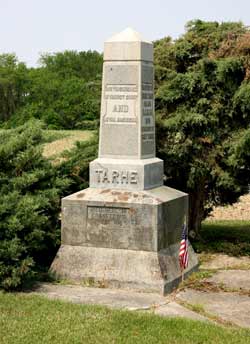
Tarhe Memorial Marker
Tarhe lived to be about 76 when he died of natural causes in 1818 in Cranetown (named after him). His funeral was, to that date, the largest ever held for a sachem. Peers among other tribes traveled from vast distances to attend. Today there is a marker at the site on Township Highway 37A about 1/2 mile west of SR67.