James A. Garfield
20th President of the United States
When James A. Garfield became the 20th President of the United States, he would also be the last man to hold that office that would have been born in a log cabin.
That 20x30 foot log cabin had been built by his father, Abram 4 years before James' birth In 1831. It was a small cabin in Cuyahoga County with only 1 room but it did have wood plank floors and 3 small windows covered with oiled paper to let light in but keep out the wind, rain and snow. And there was a ladder leading up to the loft where the 4 children slept.

ABOVE: Replica of Garfield log cabin located in Village of Moreland Hills. The log cabin is on the grounds of the Moreland Hills Police Department on SOM Center Road.
James did not grow up with the benefit of his father's guidance. James' father Abram was just thirty-three years old when he died suddenly just a few days after fighting a raging wildfire that threatened his farm and home. With Abrams passing he left behind his young wife Eliza and 4 children, with James being the youngest having not yet seen his second birthday. James early life would be one of trying to overcome the poverty of his family.
James' mother would be forced to sell most of the land. That which remained she would farm along with her oldest son Thomas, and be able to raise just enough to keep the family together rather than hand off the children to other relatives to raise. This constant struggle for food and money would be a major factor in James' life.
James grew up wanting to go to sea, but being in Ohio the nearest body of water was the Ohio and Erie Canal that years before his father helped dig. When he turned 16, James got his first job as a driver on the canal. It was far from glamorous. In fact, the canal driver was the lowest job both in pay and dignity. But for a chance accident while working on the canal, James' life may have turned out quite differently.
One night trying to coil a loose rope, James lost his balance and fell into canal. It was late at night and no one could hear his cries for help. After struggling he finally grasped a rope and pulled himself from the stagnant waters. As he composed himself, he noticed the rope which he had used to save himself from drowning was not tied off and the only thing that kept him from pulling the rope into the drink with him, was that somehow the rope has miraculously gotten wedged in a crack in the decks planking and surmised that perhaps this was some intervention on God's part to save his life for something better or more important than being a canal boat driver. It would become a point in his life that he would ponder upon for the rest of his days.
Days later James would return home, a wiser but a gravely ill young man. His unfortunate dip in the fettered waters of the Ohio and Erie Canal, had given him malaria and his mother feared that she would soon lose her youngest child. After a long convalescence and it appeared that James would recover, his mother pleaded with him to not return to the canal and instead go to school. Eliza and Thomas had together been able to save $17 that James could use for schooling. In that fall of 1851 James took the money and went to school.
Years later in 1856 James graduated from Williams College in Massachusetts and then returned to the Western Reserve Eclectic Institute (later Hiram College) in Ohio as a classics professor. Within a year he would become the schools president.
Garfield's Political Life
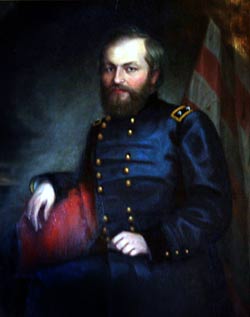
Garfield was elected to the Ohio Senate in 1859 as a Republican. During the secession crisis, he advocated coercing the seceding states back into the Union. In 1862, when Union military victories had been few, he successfully led a brigade at Middle Creek, Kentucky, against Confederate troops. At 31, Garfield became a brigadier general, 2 years later a major general of volunteers.
Meanwhile, in 1862, Ohioans elected him to Congress. President Lincoln persuaded him to resign his commission: It was easier to find major generals than to obtain effective Republicans for Congress. Garfield repeatedly won re-election for 18 years, and became the leading Republican in the House of Representatives.
 Birth of the Front Porch Campaign
James A. Garfield acquired his Mentor home in 1876 to accommodate his large family. The sprawling lawn was nicknamed by reporters who covered his reluctant campaign for the presidency as Lawnfield.
That campaign from Garfield's front porch became the first successful front-porch campaign that resulted in Garfield being elected as the 20th President of the United States. Years later, another Ohio candidate seeking the same office, Warren G. Harding, would also use the same tactic of using the front porch. For Garfield, it was less of a tactic but the result of him not actually wanting to become president and the dread he felt at being away from his devoted life-long partner Lucretia and his children. In fact, it came as some surprise that when he was elected to the presidency that he enjoyed the office more than he suspected if not for the fact that he could work from his house-- the White House.
He did not seek, he did not ask for, and he did not campaign to be the Republican nominee for President
James Garfield was known as a great orator. While in the Senate he sometimes would speak as many as 40 times in one day. Some said he was too fond of talking. Over the years he had honed his speaking abilities to a high polish that always seemed to be ready for action.
In 1880 the Republican Convention was being held in Chicago. There had been three contenders for the office of president within the Republican party. Ulysses S. Grant (who had already served 2 terms) of Ohio, James Blaine of Maine, and John Sherman also from Ohio (John Sherman was William Techumseh Sherman's younger brother).
As the convention dragged on, some hints were dropped that perhaps James Garfield would also be a good candidate for the office, but Garfield himself quickly put a damper on those ideas. It was Sherman who asked Garfield to give his nominating speech at the convention. Garfield reluctantly agreed, but his heart found it difficult to muster much enthusiasm for the nomination. So much so that on the day he was to give his nominating speech, he had yet composed a single word in support of Sherman.
It wasn't until another nominating speech by Roscoe Conkling, a senior New York Senator, for U. S. Grant. Conkling's speech so invigorated the convention that Garfield's spirits also soared as he later recalled. When it was his turn to speak he was immersed in the enthusiasm of the moment and gave a speech that brought the entire floor to its feet in applause.
After the nominating speeches were given, some delegates approached Garfield in attempts to get him to throw his hat in the ring, but he staunchly refused. Thus began the balloting in the great Chicago Hall. It would take well over 30 lengthy votes without a clear winner. There was some give in take in the voting between the three delegates. The voting dragged on for another day with similar results. Then on the 34th ballot, delegates from Wisconsin cast 16 of their 18 votes for Garfield. It came as a shock to the orator from Ohio. He immediately rose for a point of order asking if a man could be nominated that didn't wish to be nominated. The chair refused to acknowledge the point and the balloting continued.
At the end of that ballot the standings had changed, but not enough to declare a winner. Another vote was ordered, the 36th. This time Garfield won 399 votes, more than enough to become the Republican candidate. He never wanted to become a candidate. He was never nominated to be a candidate and he never campaigned to become the Republican nominee, yet here he was the Republican candidate for the office of President of the United States.
President Garfield
In the election that fall, Garfield won by a slim margin of only 10,000 popular votes, defeating the Democratic nominee, General Winfield Scott Hancock, another famous Civil War general.
As President, Garfield strengthened Federal authority over the New York Customs House, stronghold of Senator Roscoe Conkling, who was leader of the Stalwart Republicans and dispenser of patronage in New York. When Garfield submitted to the Senate a list of appointments including many of Conkling's friends, he named Conkling's arch-rival William H. Robertson to run the Customs House. Conkling contested the nomination, tried to persuade the Senate to block it, and appealed to the Republican caucus to compel its withdrawal.
But Garfield would not submit: "This... will settle the question whether the President is registering clerk of the Senate or the Executive of the United States.... shall the principal port of entry ... be under the control of the administration or under the local control of a factional senator."
Conkling maneuvered to have the Senate confirm Garfield's uncontested nominations and adjourn without acting on Robertson. Garfield countered by withdrawing all nominations except Robertson's; the Senators would have to confirm him or sacrifice all the appointments of Conkling's friends.
In a final desperate move, Conkling and his fellow-Senator from New York resigned, confident that their legislature would vindicate their stand and re-elect them. Instead, the legislature elected two other men; the Senate confirmed Robertson. Garfield's victory was complete.
In foreign affairs, Garfield's Secretary of State invited all American republics to a conference to meet in Washington in 1882. But the conference never took place. On July 2, 1881, in a Washington railroad station, an embittered attorney who had sought a consular post shot the President.
Just 100 days after Garfield assumed his duties, he was assassinated by Charles Guiteau.
Mortally wounded, Garfield lay in the White House for weeks. Alexander Graham Bell, inventor of the telephone, tried unsuccessfully to find the bullet with an induction-balance electrical device which he had designed. On September 6, Garfield was taken to the New Jersey seaside. For a few days he seemed to be recuperating, but on September 19, 1881, he died from an infection and internal hemorrhage.