Garrett Augustus Morgan
You may not know this Cleveland man, but everyday you probably see the results of one of his inventions. Garrett was born in Paris, Kentucky to parents that were former slaves. As a teenager, Garrett moved to Cincinnati to seek his fortune.
In a long and productive career that spanned over forty years, Garret A. Morgan worked diligently to create new products and services to enhance safety in modern-day living. His creations, for many of whom he held patents, brought him much fame and prosperity in his lifetime, and he was nationally honored by many organizations, including the Emancipation Centennial in 1963.
When autos first started appearing in America, there were frequent accidents, often involving horses, pedestrians and bicycles-- all using the same road. After Garrett witnessed a particularly nasty auto and horse-drawn carriage, he became convinced something could be done to improve roadway safety.
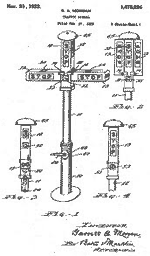 Other inventors experimented with and even marketed traffic signals, but it was Garrett Morgan who first applied for and acquired a U.S. patent for the new device. The patent was granted in 1923. Morgan later had the technology patented in Great Britain and Canada as well.
The Morgan traffic signal was a T-shaped pole unit that featured three positions: Stop, Go and an all-directional stop position. This third position halted traffic in all directions to allow pedestrians to cross streets safely. Morgan's traffic device was used throughout North America until it was replaced by the red, yellow and green-light traffic signals currently used around the world. The inventor sold the rights to his traffic signal to the General Electric Corporation for $40,000. Shortly before his death, in 1963, Morgan was awarded a citation for his traffic signal by the United States Government.
Other inventions
Garrett Morgan was constantly experimenting to develop new concepts. Though the traffic signal came at the height of his career and became one of his most renowned inventions, it was just one of several innovations he developed, manufactured and sold over the years. Morgan invented a zigzag stitching attachment for manually operated sewing machine. He also founded a company that made personal grooming products, such as hair dying ointments and the curved-tooth pressing comb.
On July 25, 1916, Morgan made national news for using a gas mask he had invented to rescue several men trapped during an explosion in an underground tunnel beneath Lake Erie. After the rescue, Morgan's company received requests from fire departments around the country who wished to purchase the new masks. The Morgan gas mask was later refined for use by U.S. Army during World War I. In 1921, Morgan was awarded a patent for a Safety Hood and Smoke Protector. Two years later, a refined model of his early gas mask won a gold medal at the International Exposition of Sanitation and Safety, and another gold medal from the International Association of Fire Chiefs. As word of Morgans life-saving inventions spread across North America and England, demand for these products grew. He was frequently invited to conventions and public exhibitions to demonstrate how his inventions worked. Garrett A. Morgan died on August 27, 1963, at the age of 86. His life was long and full, and his creative energies have given us a marvelous and lasting legacy.
In the 1920s, he organized a newspaper, the Cleveland Call. A civil rights activist, he took part in the formation of the NAACP, and in 1931 ran unsuccessfully for Cleveland's city council on a platform of fair housing, employment, and representation for all people. His declining years were marred by glaucoma, but he maintained an interest in inventions until his death in 1963.